The Man Who Looked Too Long
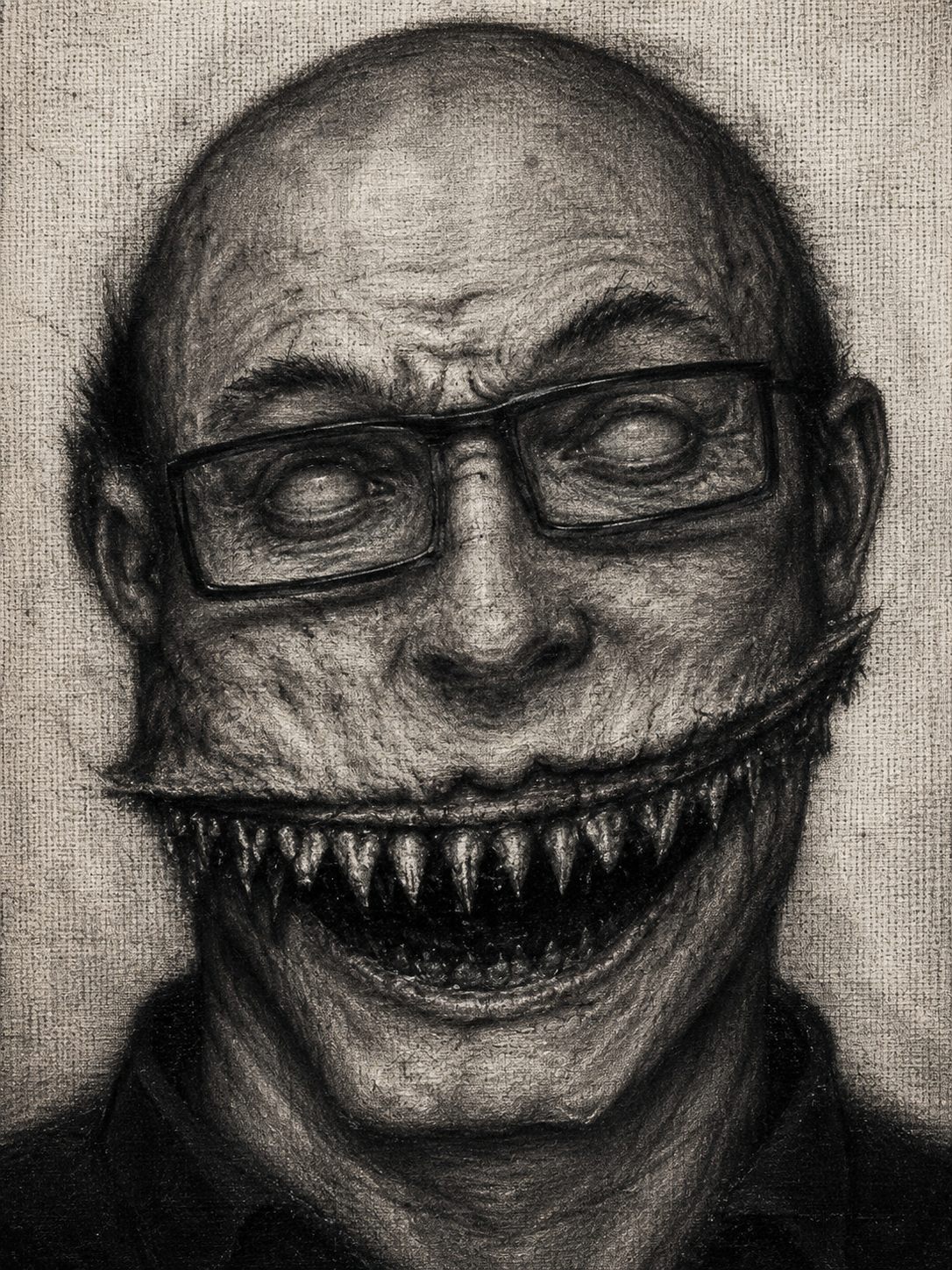
THIS IS A WORK OF FICTION
At half past eight on a Thursday morning, when Shyambazar had already begun conducting its daily orchestra of horns, curses, bicycle bells, fishmongers, and the metallic cough of buses, Nandita Sen watched a man’s teacup boil in his hand.
It happened outside Madan’s stall, under the leaning nest of tram wires near the crossing. The city was wet though it had not rained. In Calcutta, damp has never required weather. It rises obediently from drains, walls, collars, old newspapers, family histories.
Madan had just poured tea into six thick glasses arranged on the counter like small brown lanterns. Office clerks were performing their usual delicate ballet of lateness and superiority. A hawker selling belts shouted that his leather was original, which in that lane meant original to somebody. A schoolboy licked ghugni off his thumb. A woman in a faded blue sari argued with an auto driver about five rupees as if the Republic depended on it.
Then Buro Pal, retired railway accounts clerk and champion interrupter, lifted his glass and screamed.
The tea had not spilled. That was the first wrong thing. His fingers tightened around it, whitening. Steam rose, not from the tea, but from the skin between his fingers. The glass darkened. Tiny cracks ran through it like black veins. Buro’s scream became a child’s sound. Madan slapped the glass away with a rag. It hit the pavement and broke neatly in two, releasing no tea at all. Inside, the liquid had thickened into a brown jelly, trembling.
“Pressure cooker tea now?” somebody said, because in Calcutta even terror must first pass through commentary.
Nandita pushed through the gathering crowd. She was thirty-six, a tuition teacher, unmarried in a family that treated this as both medical condition and moral defect. She lived two lanes away with her mother, her younger brother Anirban, and three species of unpaid bills. Her sandals slapped black water from a pothole onto her calves.
“Move,” she said. “Give him air.”
“Air? His hand is cooked,” Madan said.
Buro sat on an upturned crate, weeping, his fingers red and glossy. Nandita wrapped them in the clean end of her dupatta and told a boy to fetch ice.
“Not ice, didi,” said a thin voice behind her. “Running water first. Ice will hurt more.”
She turned.
Anirban stood under the paan shop awning, wearing his new spectacles.
New, though they looked old-fashioned: thick black frame, round lenses, the sort a serious Bengali boy might wear in a college photograph before disappointing everyone. His head almost bald. He had lost weight. The collar of his shirt curled outward with the exhausted dignity of failed laundry.
“When did you come?” she asked.
“Last night.”
“You didn’t tell me.”
“You were asleep.”
“I was correcting Class Ten answers till two.”
“Same thing.”
His eyes were hidden by a faint gray tint in the lenses. Not sunglasses. Something subtler, like smoke trapped in glass.
Buro looked up and saw him.
“You,” the old man said.
The crowd made its little inhaling sound. Calcutta crowds love accusation. It gives them a spine.
Anirban smiled, not broadly. A dry, narrow smile.
“Me, Buro-kaku?”
“You were looking at me.”
“Many people look at you. You speak loudly.”
Buro tried to stand, then sat again.
Nandita caught Anirban by the elbow. His arm felt hot through the cotton.
“Come home,” she said.
He let himself be led away. Behind them the lane resumed, but uncertainly, like an actor who had forgotten his next line. A bus belched smoke. Madan cursed the municipality, then God, then foreign countries, covering all available departments.
At home, their mother, Leela, was sitting before the television with the sound off, watching a soap actress cry extravagantly beside a staircase wide enough to park a tram. The room smelled of coconut oil, damp clothes, and the faint medicinal sweetness of Leela’s diabetes tablets.
“You came,” she said, without looking away from the screen.
“I told you I would,” Anirban replied.
“You also told me you would clear NET.”
Nandita made a small warning noise.
Their mother’s tongue had become sharper after their father died. Grief had not softened Leela Sen. It had boiled her down. What remained was salt.
Anirban put his cloth bag on the table. From it he removed a metal spectacle case and a notebook bound with black tape. Nandita noticed his hands. There were small brown marks on the fingertips, like burns from incense.
“Where were you all these months?” she asked.
“Working.”
“Doing what?”
“Research.”
“Research pays?”
He laughed.
This was the new laugh: not amusement, but a match struck in an empty room.
For years Anirban had been the family’s proof that brilliance could still rescue them. First class in physics from Scottish Church, then scholarships almost received, interviews almost cleared, positions almost offered. The great middle-class Bengali machine had fed him all its remaining coins: coaching, photocopies, secondhand textbooks, relatives’ advice, mother’s gold bangles. It had produced, after eleven years, one thin man with no job and an opinion on every failure of civilization.
Society, he said, had no place for merit. Society preferred nephews, flatterers, English-medium donkeys, political boys, software clerks, boys who knew how to touch feet at the proper angle. Physics had taught him symmetry. Calcutta taught him queues. In queues, symmetry died.
Nandita understood some of his anger. She had stood in staff rooms where men half as qualified explained her own subject to her. She had watched parents bargain over tuition fees while spending more on puja lights than on their daughters’ algebra. But Anirban’s anger had changed flavor lately. It no longer wanted justice. It wanted an audience.
That afternoon, she found three dead cockroaches in a straight line under his table.
Not crushed. Not poisoned. Their bodies were intact, legs curled politely inward. Around each was a tiny halo scorched into the dust.
“Use phenyl,” her mother said when Nandita showed her.
“Phenyl doesn’t arrange cockroaches.”
“Maybe educated cockroaches.”
The next incident happened two days later at the ration shop.
Nandita heard about it before she saw it, because news in the para moved faster than police and with less paperwork. The ration dealer’s assistant, a broad boy named Tapan who had once mocked Anirban by calling him “Professor Unemployment,” had collapsed while weighing rice. His right cheek blistered in three neat patches, round as coins. He kept shouting that the air had bitten him.
Anirban returned that evening with a kilo of rice and a quiet expression.
“Tapan is in hospital,” Nandita said.
“Yes.”
“You saw?”
“Yes.”
“What happened?”
“Maybe bad character came out through skin.”
“Don’t joke.”
“I am not joking.”
She slapped him.
It surprised them both. The sound was small but intimate. Their mother turned from the stove.
Anirban touched his cheek. For a moment he looked like the boy who had once cried because a stray kitten died under a taxi. Then the spectacles caught the tube light and went blank.
“You still think punishment is only allowed when official people do it,” he said.
“What punishment? For what?”
“For living like kings in their small dirty kingdoms. For insulting. For cheating. For making everyone stand with folded hands.”
“Tapan cheats on rice, so his face should burn?”
“He will remember honesty.”
“He will remember pain.”
“Same teacher, different handwriting.”
Leela stirred dal too violently. It splashed on the stove and hissed.
“Enough,” she said. “Neighbors will hear.”
There it was: the oldest law. Not right, not wrong. Neighbors.
That night the power went out. The room turned thick and black. Outside, someone on a balcony shouted at the electricity board with impressive anatomical creativity. A baby cried. Mosquitoes discovered the human race anew.
Nandita lay awake on the floor beside her mother’s bed. In the next room, Anirban murmured to himself. At first she thought he was reciting equations, as he used to before exams. Then she heard names.
“Buro Pal. Tapan. Dasgupta. Jhuma’s father. The man at Presidency. The landlord.”
She got up.
A line of light showed beneath his door, though the electricity had gone. Not yellow light. A pale, hard shimmer, like moonlight squeezed through metal.
She pushed the door.
Anirban sat at the table wearing the spectacles. Before him stood an old steel tiffin box. He was staring at it with terrible concentration. The lid trembled. A smell rose into the room: hot iron and old food.
“Nanda,” he said softly, without turning. “You should knock.”
“What are you doing?”
“Learning aim.”
The tiffin lid buckled inward with a ping.
Nandita stepped back.
Anirban removed the spectacles. Without them, his eyes looked naked and tired.
“Don’t be afraid,” he said.
“I am very afraid.”
“Of me?”
“Yes.”
He absorbed this as if she had offered him medicine too bitter to swallow.
“You don’t know what they did.”
“Who?”
“All of them.”
“All of Calcutta did something to you?”
He smiled again, but his mouth shook.
“You remember the interview at the college?”
Nandita did. Three years earlier, she had borrowed a sari from a neighbor and gone with him to a college near Sealdah where a temporary lecturer post had opened. They had waited four hours in a corridor under a framed photograph of a dead education minister. The chosen candidate had arrived late, smelling of aftershave, and been ushered in with tea.
“You said forget it,” Anirban said. “You said something else will come.”
“What else could I say?”
“You could have said burn it down.”
“You were hurt.”
“I was erased.”
He opened the black notebook. Nandita saw pages of diagrams, lenses, arrows, equations, then lists of names. Some crossed out. Some circled. At the top of one page he had written: PEOPLE WHO TEACH THE WORLD TO BE SMALL.
She reached for the notebook. He closed it.
“No.”
“Give it to me.”
“You will not understand.”
“I understand enough.”
“Do you?” His voice sharpened. “Every morning they step over me. Mother doesn’t say my name without attaching a failure certificate. You hide money in old envelopes because you think I will ask. Children I tutored now earn more than our whole family by speaking bad English in glass offices. Aunties ask about me with their pity-smiles. Men who cannot spell quantum sit on selection committees. And you still say, ‘Be decent, Anirban. Be patient.’ Patience is what the weak are fed so the strong can finish eating.”
Nandita said nothing for a moment. Outside, rain began suddenly, a fat monsoon rehearsal slapping the balcony grille.
Then she said, “Baba was patient.”
Anirban looked at her.
Their father had taught physics in a school and died in a government hospital corridor after eight hours of waiting for a bed. He had been patient in the way poor decent men are patient: because rage costs money. Anirban had not cried at the funeral. He had watched the priest mispronounce their gotra and corrected him.
“Baba died because nobody looked,” Anirban said. “I learned to look.”
The next morning, Nandita went to Madan’s stall before her tuitions.
“Did Anirban come here before Buro-kaku’s hand burned?” she asked.
Madan looked uncomfortable. Men who serve tea to everyone know everything and prefer being paid not to.
“He stood there,” Madan said. “Quiet. Buro was saying your brother should sell phuchka. Educated phuchka. With formula.”
“And then?”
“Then Buro shouted.”
“Was Anirban touching anything?”
“No. Only looking.”
Madan leaned closer.
“Didi, yesterday a dog went mad near the drain. Barking at your brother. He looked once. Dog ran away crying. Its fur smoked. I saw. My eyes are not government eyes.”
Nandita missed two tuitions and spent the afternoon searching Anirban’s room while he was out.
The black notebook was gone. The metal case lay under his pillow. Empty. In the drawer she found their father’s old shaving mirror, its center clouded into a white scar. She found a burnt matchbox, though Anirban did not smoke. She found a torn college rejection letter folded around a lock of gray hair.
The hair was their mother’s.
She sat on the bed, suddenly cold.
Leela had been losing hair for months. They had blamed age, sugar, tension, cheap shampoo. Nandita remembered small things now, each one unpleasantly patient: her mother rubbing the back of her head after arguing with Anirban; the round bald patch near her left temple; the way Anirban watched when Leela said, “What use is a son who cannot buy fish?”
That evening Nandita followed him.
He walked from their lane to Bidhan Sarani, then toward an old cinema hall converted into a storage building for wedding decorations. Posters of forgotten heroes peeled from the walls, their heroic chests defeated by fungus. He entered through a side gate.
Inside, the hall smelled of dust, rat droppings, damp velvet, and stale glamour. Rows of broken seats faced a torn screen. On the stage, plastic lotus flowers and thermocol pillars leaned together in retirement.
Anirban stood in the aisle.
Facing him, near the screen, was their landlord, Haradhan Saha: white kurta, gold ring, belly like a legal notice. He had come with two young men.
“So, Professor,” Haradhan said, “your sister sent you? Rent is not an abstract concept.”
“I sent myself,” Anirban replied.
Nandita crouched behind a row of seats.
Haradhan laughed. “Good. Then listen. Month end, pay two months. Otherwise I put lock. Your mother can sit on pavement and discuss physics.”
One of the young men snorted.
Anirban lifted his face.
The hall seemed to tighten.
Nandita saw the spectacles catch light where there was no light to catch. The air in front of Haradhan shimmered faintly, as above summer asphalt. Haradhan stopped smiling. He touched his forehead.
“What is this heat?”
“Respect,” Anirban said. “Late, but arriving.”
Haradhan’s gold ring clicked against his skull as he clutched his head. The two young men backed away.
Nandita ran down the aisle.
“Anirban!”
He flinched. The shimmer broke. Haradhan fell to his knees, vomiting.
“Enough,” Nandita said.
Anirban turned on her with a look of almost comic betrayal.
“You followed me?”
“Yes.”
“You still protect him?”
“I am protecting you.”
“From what? Success?”
“From becoming a murderer in a rotting cinema.”
He laughed, and the laugh echoed up into the balcony where pigeons shifted uneasily.
“Murderer. Big word. Did they murder Baba? No. They delayed. They misplaced. They regretted inconvenience. They said come tomorrow. That is not murder. That is administration.”
Haradhan crawled toward the exit. One of the young men tried to help him. Anirban looked at them.
Nandita picked up a broken seat handle and struck her brother across the face.
The spectacles flew off and skidded under a row.
Anirban made a sound not of pain but of loss. He dropped to his hands and knees, feeling blindly.
“Don’t touch them,” Nandita said.
The young men fled with Haradhan, all dignity abandoned in the democratic style of panic.
Anirban found the spectacles and held them to his chest.
“You don’t know,” he whispered.
“Then tell me.”
He sat back among the dead cinema seats. Blood ran from his eyebrow.
“I didn’t invent it first,” he said.
The rain outside hammered the tin awning, turning the whole old hall into a drum.
“It was Baba’s,” he said.
Nandita stared at him.
“That is not funny.”
“His notebooks. Hidden in the trunk. He built a crude version in the seventies. During the Emergency. Students disappearing. Police beating boys in lanes. He wanted a way to frighten them without touching. He never used it.”
“Baba would not—”
“Baba was not a saint. He was a man who swallowed fire until it looked like manners.”
Anirban wiped blood from his eye.
“I improved it. Made it wearable. Precise.”
“No details,” she said, absurdly, as if he were a student giving too much answer in class.
He smiled weakly.
“Always teacher.”
“What about Ma’s hair?”
The smile died.
For a long time, only rain spoke.
“She said Baba wasted his life,” he said.
“So you burned her?”
“A little. I was angry.”
“A little?”
“She didn’t know.”
“That makes it better?”
His face crumpled then, not beautifully, not dramatically. Like wet paper.
“I can’t stop when I start looking,” he said. “At first it was funny. Cockroaches. Tea. That old fool’s hand. Then I began seeing marks on everyone. Their insults. Their cheapness. Their little cruelties. The whole city walking around with targets.”
Nandita sat beside him. The torn screen stirred in a draft.
“You have to give them to me.”
“No.”
“Then police.”
“They will laugh.”
“Not after the next body.”
He looked toward the balcony.
“There is already one.”
The words landed softly.
“Who?”
“Dasgupta.”
Nandita knew the name from his list. Professor Dasgupta, retired, once on an interview panel, owner of a famous condescending cough.
“When?”
“Yesterday.”
“What did you do?”
“He was feeding pigeons on his terrace. I only wanted him to feel headache. Just headache. But he turned. The beam—”
“Stop.”
“He fell.”
From the balcony above came a flutter.
Both of them looked up.
A pigeon dropped from the darkness and struck the aisle near their feet. Its feathers were warm. Its eyes were white.
Anirban began to sob.
Not for Dasgupta, Nandita thought. Not yet. For himself, perhaps. For the clever boy still trapped somewhere inside the clever weapon. For the grand injustice that had shrunk into a pair of spectacles in a dead cinema.
She reached for them.
This time he let her take them.
The frame was warm, almost alive. Up close the lenses were not gray but faintly milky, with tiny scratches radiating from the center. Their father’s initials were etched inside one arm: S.S.
Nandita remembered ordinary things: Baba cleaning his glasses every night with the end of his vest; Baba staring silently at the hospital clerk who said no beds; Baba’s spectacles missing after his death; Anirban insisting they must have been lost in the ward.
“You found them at the hospital,” she said.
Anirban nodded.
“In his shirt pocket.”
“You lied.”
“I wanted something of his.”
“No,” she said. “You wanted his anger.”
Anirban looked at her, and for the first time in months he did not argue.
The final choice was not grand. Most final choices are not. They arrive tired, wet, badly lit, with no music.
Nandita carried the spectacles to the projection room while Anirban followed, begging, then cursing, then begging again. The old projector remained there under a tarpaulin, a fossil from the age when light had to travel through film before becoming human faces.
She placed the spectacles on the iron floor and lifted a brick from the corner.
“If you break them,” Anirban said, “we are nothing again.”
“We were never this.”
The first blow cracked one lens. A sharp heat leapt up her arm. She screamed but struck again. The second lens burst with a sound like a bulb dying. For an instant the room filled with a pale white glare.
In it she saw her father.
Not as a ghost standing politely in the corner. Not as a blessing. As a memory suddenly corrected.
He was in the hospital corridor, not patient, not resigned. He was sitting upright on a wooden bench, spectacles in hand, staring at the clerk behind the desk. The clerk’s pen had begun to smoke. Nandita, younger and frightened, had touched her father’s wrist.
“Baba,” she had said. “Please.”
He had stopped.
The clerk never knew. The bed came twenty minutes later. Too late.
Then the glare vanished.
The broken spectacles lay on the floor like two dead insects.
Anirban had seen it too. She knew by his face.
“He used it,” he whispered.
“He chose not to continue.”
“He died anyway.”
“Yes.”
This was the cruelty no invention solved.
Outside, sirens approached. Perhaps Haradhan had found courage from a safe distance. Perhaps one of the young men had called the police. Perhaps Calcutta, after long rehearsal, had finally decided to arrive at an event before it ended.
Nandita picked up the blackened pieces in her burned hand.
“What will you say?” Anirban asked.
“The truth.”
“They will hang me.”
“No. They will first misunderstand completely. Then they will ask for diagrams. Then someone will lose the file.”
He gave a small, broken laugh. It sounded almost like the old one.
At the door of the projection room, he stopped.
“Nanda?”
“What?”
“When Ma asked what use I was, I looked at her only for one second.”
Nandita closed her fist around the ruined frame until glass bit skin.
Below, men shouted. Rainwater ran through the cinema roof and fell in separate drops on separate seats, each one darkening the dust around it.
For years afterward, Leela Sen would keep a round bald patch near her temple, smooth as a coin. When neighbors asked, she would say it was age, sugar, tension, cheap shampoo. Respectable explanations. Calcutta has cupboards full of them.
But sometimes, in the late afternoon, when the lane outside went briefly quiet and the tram wires hummed in the heat, Nandita would catch her mother staring at nothing with one hand covering that spot, and she would know the old woman remembered not pain, not heat, not even fear, but the terrible intimacy of being punished by someone she loved, from across the room, without a single touch.